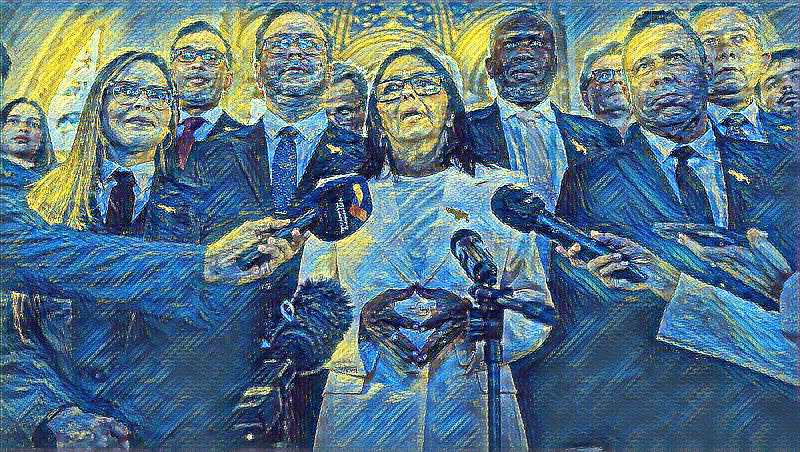
Venezuela's acting President Delcy Rodríguez strongly refuted claims that her nation might become the 51st US state, while simultaneously defending its territorial claims over the Essequibo region before the International Court of Justice (ICJ).
Rejection of US Statehood Claims
Speaking to journalists in The Hague, Rodríguez addressed comments made by Donald Trump regarding Venezuela's potential status as a US state. The remarks surfaced after Trump stated he was "seriously considering" the move.
- Rodríguez affirmed Venezuela's commitment to defending its sovereignty and integrity.
- She emphasized that Venezuela is a "free country," not a colony.
These comments followed Trump's earlier remarks on Fox News, which were reported by co-anchor John Roberts.
Focus on Essequibo Territorial Dispute
Rodríguez's primary focus during her appearance was defending Venezuela's claim to the Essequibo region against Guyana at the ICJ. She argued that the dispute must be resolved through political negotiation, not judicial ruling.
Key points regarding the dispute include:
- The Territory: The Essequibo region covers approximately 62,000 square miles and constitutes two-thirds of Guyana.
- Resources: The area is rich in natural resources, including gold, diamonds, and timber, and is near massive offshore oil deposits.
- Historical Context: Venezuela claims the region since the Spanish colonial period. An 1899 arbitration decision, involving Britain, Russia, and the US, drew the border largely favoring Guyana.
- Legal Framework: Rodríguez highlighted the 1966 Geneva Agreement, arguing it nullified the 19th-century arbitration and mandates negotiation between the two nations.
Diplomatic Tensions and Court Proceedings
Rodríguez criticized Guyana for taking the dispute to the ICJ, suggesting this was an "opportunistic" move coinciding with the 2015 discovery of major offshore oil fields. She stated that the Geneva Agreement was designed to keep the matter in the negotiating arena.
- Guyana's Stance: Guyana's foreign minister, Hugh Hilton Todd, told the judges that the dispute has been a "blight on our existence as a sovereign state."
- Venezuela's Position: Venezuela warned that its participation in the hearings does not imply consent to or recognition of the court's jurisdiction.
These proceedings follow heightened tensions, including threats from Rodríguez's predecessor, Nicolás Maduro, to annex the region by force in 2023.