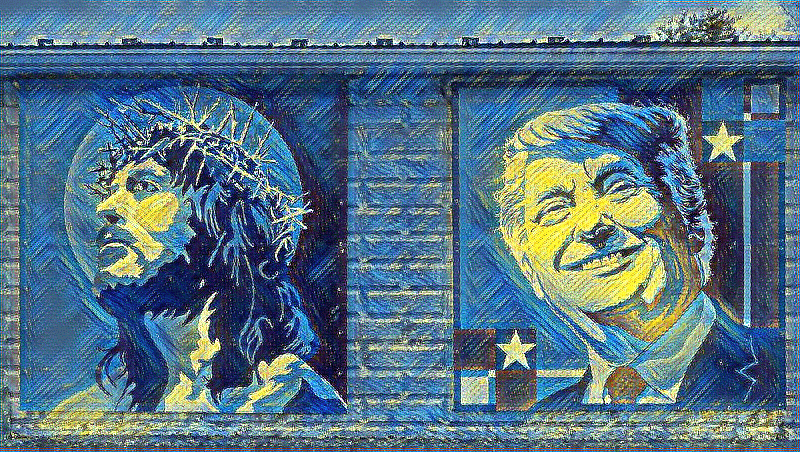
The public disagreement between Pope Leo XIV and Donald Trump transcends mere political rhetoric; it represents a deeper conflict over competing interpretations of Christian faith. This ideological battle pits the traditional, pacifist teachings of Christ against a militaristic, nationalist version embodied by the 'MAGA Jesus.'
The Core Conflict: Two Christs
Pope Leo XIV is not merely criticizing a political figure; he is challenging the theological underpinnings of the 'MAGA Jesus' narrative. This contrast highlights a significant divergence in Christian thought:
- Traditional Jesus: Portrayed as the nonviolent, itinerant teacher who preached doctrines like the Beatitudes ("blessed are the meek").
- 'MAGA Jesus': Described as a 'warrior Christ,' echoing imagery from the Book of Revelation—featuring eyes like 'flames of fire' and a blood-dipped robe—who leads armies.
This 'MAGA Jesus' is visually associated with political rallies, exemplified by the image of a figure wearing a 'Make America Great Again' hat, a version of Christianity Trump has alluded to when linking divine support to military action, such as the conflict with Iran.
The Rise of 'MAGA' as a Religious Movement
Experts note that the appeal of this warrior Christ is tied to the broader political movement. Peter Wehner observed that right-wing movements are moving Christianity away from its core ethics. He argued that the Trump administration has "invert[ed] authentic Christian faith by selling in a dozen different ways cruelty and the will to power in the name of Jesus."
This ideology forms a distinct theology, characterized by:
- White Christian Nationalism: The belief that America was founded as a Christian nation.
- End Times Beliefs: Some evangelicals view the conflict with Iran as a sign that the world is approaching the Second Coming of Christ.
Pope Leo's Theological Counter-Narrative
Pope Leo XIV draws authority from the foundational Gospels and Catholic social teachings, which mandate care for the vulnerable and oppose violence. His recent statements reflect this traditional teaching:
- He has termed Jesus the "King of Peace, who rejects war."
- He cited scripture suggesting God rejects the prayers of leaders who initiate conflict and "have hands full of blood."
- His criticism of the Iran conflict on social media stated that any disciple of Christ "is never on the side of those who once wielded the sword and today drop bombs."
Political Implications and Debate
While some dismiss the Pope's rebukes as minor, his moral authority as the Vicar of Christ remains significant. Furthermore, Pope Leo's American upbringing prevents him from being easily dismissed as a foreign political agitator, unlike some predecessors.
However, the debate is complicated by political figures like Vice President JD Vance, who questioned the Pope's stance, arguing that divine support should be acknowledged for military actions like the liberation of France from Nazis.
Ultimately, the clash between Pope Leo and Trump, while highly publicized, obscures a deeper, necessary debate regarding the Catholic Church's Just War theory—the doctrine stating that military force is permissible only after all peaceful efforts have failed. This debate is set to intensify if the conflict in the Middle East escalates, deepening existing national divisions.