BN
|
WorldAI Desk1 views

Deadly LaGuardia Airport collision highlights ‘heavy workload’ for air traffic controllers

Vụ va chạm giữa máy bay Air Canada Express và xe cứu hỏa tại sân bay LaGuardia (New York) vào tối Chủ nhật làm 2 phi công thiệt mạng và hàng chục người bị thương. NTSB điều tra nguyên nhân, tập trung vào việc hai kiểm soát viên không lưu đang làm việc ca đêm có thể đảm nhận nhiều vị trí do thiếu nhân sự. Các chuyên gia cho rằng việc kết hợp vị trí cùng hệ thống công nghệ cũ làm tăng nguy cơ, đặc biệt khi lưu lượng bay tăng đột biến. FAA đang nỗ lực tuyển dụng và nâng cấp hệ thống, nhưng vẫn đối mặt với thách thức về nhân sự và công nghệ lỗi thời. Vụ việc nhấn mạnh những lo ngại lâu năm về áp lực công việc và an toàn trong ngành hàng không.

Ad slot
Deadly LaGuardia Airport collision highlights ‘heavy workload’ for air traffic controllers

Washington, DC —

After this week’s deadly collision at LaGuardia Airport, concerns about how much is too much for one air traffic controler to handle have reopened.

Sometimes, controllers in the tower are responsible for planes preparing to take off and can also be tasked with handling those in the air or on the ground.

“It happens in every facility as the traffic winds down, especially at night. You begin to combine positions,” said Harvey Scolnick, a retired air traffic controller, who worked for 42 years for both the military and Federal Aviation Administration. “When the time permits, you combine it to one position — ground control, local control, clearance, delivery — you combine them down to one position. But you try to do it at such a time when the traffic permits.”

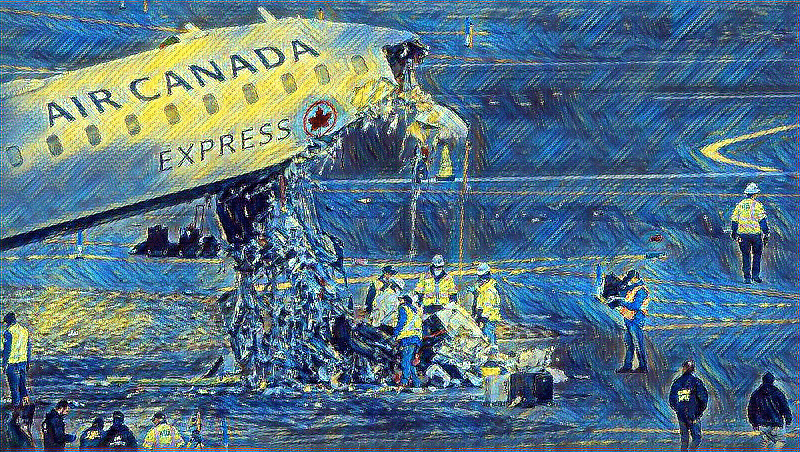
On Sunday, just before midnight, Air Canada Express Flight 8646 was landing at LaGuardia Airport when it plowed into a firetruck. Two controllers were working in the tower cab at the time, the top of the tower that looks out over the airfield, the NTSB confirmed on Tuesday.

The “local controller” was in charge of active runways and the immediate airspace surrounding the airport. The “controller in charge” was a supervisor responsible for the safety of operations, and that night, they were also assigned to give pilots departure information. One of them – the NTSB is still trying to determine which one – was also responsible for the aircraft and vehicles on the ground.

The plane had 72 passengers and four crew members on board for the one-hour flight from Montreal to New York’s LaGuardia. The two pilots died and dozens of passengers and two firefighters in the emergency vehicle were injured.

While it is far too early to know what caused the crash, National Transportation Safey Board Chair Jennifer Homendy said there’s a systemic issue when positions are combined due to short staffing during the late-night hours.

“Our air traffic control team has stated this is a problem, that this is a concern for them for years,” Homendy told reporters on Tuesday. “I can understand it’s a concern, especially if there’s a heavy workload.”

Combining roles in the tower

Two controllers were working during the midnight shift on Sunday, which may have been standard for LaGuardia at that time of the night. The NTSB will investigate if that procedure was adequate.

CNN aviation analyst and former NTSB managing director Peter Goelz says combining air traffic control positions may work during a normal drop in flights late at night, but he believes it “will be determined as a contributing factor to this accident.”

Goelz says traffic at LaGuardia that night surged due to earlier bad weather and delays due to the TSA staffing shortages at airports nationwide, with dozens of late arrivals overwhelming what is typically a reduced workload.

“The reality is you have to staff for the ultimate bad evening,” Goelz said. “You need to be able to pick up a challenge when you’ve had storms, when you’ve had delays.”

Instead, he said, controllers are often left managing too much at once in an already strained system.

“We’re working with an antiquated system and a workforce that is overworked and undermanned,” he said. “That is just a deadly combination.”

The control tower at LaGuardia Airport in New York City. Mike Segar/Reuters

As air traffic continues to increase, Goelz warned combining air traffic control positions is “really just playing with fire.”

Yet, Scolnick said if there were any questions about compromising safety, a supervisor would ask a controller to stay later for overtime.

“It seemed to me that it wasn’t a terrible decision to combine positions there, but they did,” Scolnick said. “It was just a freak accident.”

Combining positions is a problem the NTSB has tried to navigate before.

When an Army Black Hawk helicopter and an American Airlines regional jet collided in January 2025 at Ronald Reagan Washington National Airport, investigators found one controller was overloaded managing two positions.

“The tower team’s loss of situation awareness and degraded performance due to the high workload of the combined helicopter and local control positions” was listed as one of the factors that caused the collision that killed 67 people.

An independent panel, commissioned by the FAA in 2024, found that combining positions can be a sign staffing is not sufficient to safely manage demand, particularly during busy periods.

It also highlighted a key vulnerability: Controllers working midnight shifts reported feeling least rested and least mentally sharp and found that the use of combined positions increased controller fatigue over time – especially when layered with weather disruptions, extended shifts or emergencies.

Just before Sunday’s collision, controllers were dealing with another plane that had declared an emergency after aborting a takeoff and smelling an odor on the plane. It was that emergency the controllers were sending the firetruck to when the collision occurred.

Ad slot

The panel that issued the 2024 report, also urged the FAA to further study how alertness and fatigue are monitored — and underscored concerns that consolidating responsibilities can reduce safety margins at exactly the wrong time.

‘I messed up’

Air traffic control is a high stress environment – the decisions made are critical to safety, and after an accident every action by the controllers involved are scrutinized, but Homendy warned against “pointing fingers” at the air traffic controllers in the tower that night.

“Our aviation system is incredibly safe because there are multiple, multiple layers of defense built in to prevent an accident, so when something goes wrong, that means many, many things went wrong,” she said.

Eighteen minutes after the collision, one controller appeared to blame himself for the crash in a conversation with a pilot who saw it happen.

“That wasn’t good to watch,” the pilot said in audio recorded by LiveATC.net.

“Yeah, I know. I tried to reach out to them,” the noticeably distraught controller said. “We were dealing with an emergency earlier. I messed up.”

The pilot responded, “Nah man, you did the best you could.”

Following the incident, the National Air Traffic Controllers Association, which represents controllers, said it would support the controllers involved through the union’s Critical Incident Stress Management program.

“Air traffic controllers work every day to keep passengers and cargo moving safely and efficiently,” the union said in a statement shortly after the incident. “We serve quietly, but moments like this remind us of the responsibility we carry—and how deeply it stays with us when tragedy occurs.”

The NTSB will also investigate why the controllers continued to direct planes for some time after the crash.

“We have questions about that. Was anybody available to relieve that controller? We don’t know that yet,” Homendy said.

Another lingering question: who was controlling the planes on the ground?

Scolnick called it “very weird” that the NTSB could not immediately confirm who was doing ground control. He said controllers should’ve signed off on a log that night for their positions.

“When they say they’re not sure, it could be that they forgot to sign the log over, and they need a witness to tell them what happened,” Scolnick said. “That’s a possibility.”

Officials investigate after an Air Canada Express plane collided with a fire truck on the tarmac at LaGuardia Airport in New York City. Spencer Platt/Getty Images

What hiring looks like today

The FAA has needed to hire and train thousands of new air traffic controllers to fully staff the nation’s air traffic control system but has struggled for years to recruit enough people to overcome the shortage.

Last year, the FAA and Department of Transportation made efforts to “supercharge” air traffic control hiring, offering a streamlined process and pay incentives.

In September, the DOT said it met its hiring goals for the year by recruiting more than 2,000 people, but then a setback – the longest shutdown in American history. Due to that lapse in funding, some trainees dropped out of the air traffic control academy, according to Transportation Secretary Sean Duffy.

The DOT also incentivized controllers approaching the mandatory retirement age of 56 to stay on the job in 2025. A lump sum payment of 20% of the basic pay of a retirement eligible controller was promised for each year they continue to work.

The FAA told CNN it is still scheduling trainees to enter the Academy in early 2026. Duffy’s plan is “on track to hire at least 8,900 new air traffic controllers through 2028,” according to the FAA.

Old technology increases the workload

Despite a major push to upgrade systems, decades-old technology is still being used by controllers.

After the January 2025 midair collision over the Potomac River, heightened attention focused on the “floppy discs” and “paper strips” still being used by controllers to manage air traffic.

In May, the DOT announced it would replace the infrastructure by building an entirely new air traffic control system for $31.5 billion. The president’s funding bill that passed last year secured $12.5 billion to start work.

“This is 2026,” Homendy said Tuesday. “The secretary talks about upgrading our air traffic control system. We have an old air traffic control system. This is why he talks about that. We need to upgrade, but we also need to improve safety across the air. It’s not just air traffic control; it’s safety all around.”

Ad slot