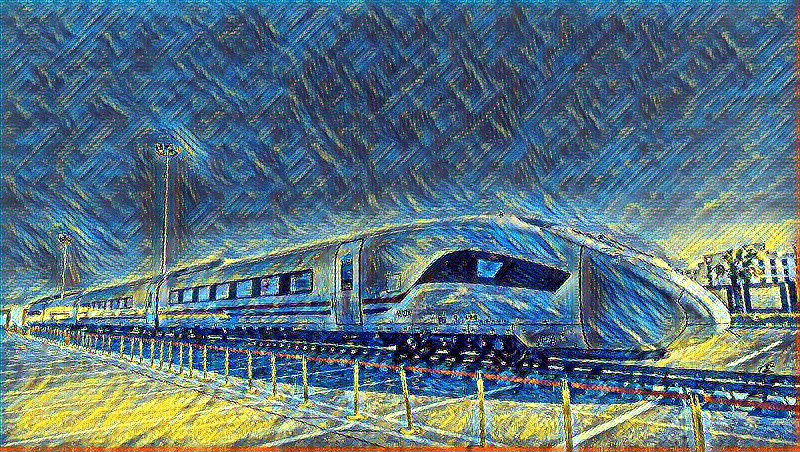
Ambitious plans are underway to build a high-speed rail network across Africa, connecting countries, regions and creating a transcontinental beltway that can transport people at up to 320 kilometers per hour (199 mph) and freight at up to 120 kilometers per hour (75 mph).
But in addition to the sizable political and financial barriers that must be overcome, there’s another big challenge: track gauge.
The distance between the two inner rails on a track varies across the continent’s existing railways. In Southern Africa and Central Africa there’s Cape gauge (1.065-1.067 meters or 42 inches), used in over 60% of the continent’s lines. In parts of East Africa and West Africa there is meter/narrow gauge (0.95-1.0 meter or 37-39 inches). There’s also standard gauge (1.435 meters or 57 inches), mostly in North Africa.
This is largely down to infrastructure planning in the colonial era, when European nations exported their track and carriage measurements, Eric Ntagengerwa, head of the transport and mobility division at the African Union (AU) Commission, told CNN.
Africa has approximately 83,000 kilometers (52,000 miles) of railway — much less than the global average per square kilometer of land. Most lines penetrate inland from coastal ports before petering out. Some have branches, but interconnectivity is poor, especially outside Southern Africa. Average speeds are 35-50 kilometers per hour (22-31 mph) and only a small percentage of line is electrified.
The AU made rail a priority in 2013 as part of its development roadmap Agenda 2063, and is implementing a 50-year masterplan to overhaul its railways, comprising the African Integrated Railway Network and African Integrated High Speed Railway Network (AIHSRN).
“The first (phase) is made of 13 priority links: two, three, even four countries coming together to have a railway line which can connect between themselves,” Ntagengerwa said.
For example, one pilot project will connect Dar es Salaam, Tanzania, to Kigali, Rwanda, and from the Rwandan capital north to Kampala, Uganda.
Eight links are either already operational or in construction, he added, noting progress in the eastern corridor, singling out the Addis Ababa, Ethiopia, to Djibouti standard gauge line that opened in 2018. (The line was built by Chinese contractors and majority financed by loans from Chinese state banks as part of the nation’s Belt and Road Initiative.)
Kenyan President William Ruto (left) and Ugandan President Yoweri Museveni (right) attend the launch of construction of the Kisumu-Malaba Standard Gauge Railway (SGR) line in Kisumu, Kenya, on March 21, 2026. The line will connect landlocked Uganda to Kenya, replace old colonial infrastructure and form part of a network ending at the coastal city of Mombasa. Brian Ongoro/AFP via Getty Images
The “critical issue” for the next phase will be to connect landlocked nations in Central Africa, said Ntagengerwa, who is pushing for more construction in the next five to 10 years along a central corridor.
Ensuring network integration across the continent requires adapting existing infrastructure and standardizing new infrastructure.
“You need to have an interoperable system, it needs to move seamlessly across countries,” said Ntagengerwa, explaining the AU has outlined a package of specifications and standards to help harmonize new construction.
A map of the master plan up to 2043 outlines about 73,000 kilometers (45,000 miles) of standard gauge line connecting commercial and administrative centers. That’s more than four times the length of standard gauge on the continent today.
Standard gauge would be used for high-speed sections of the network, connecting capital cities and commercial and tourist hotspots, explained Joster Imbuchi, a civil and structural engineer and adviser to the African Union Commission on rail, in an email.
Imbuchi said there was no plan to replace all narrow gauge lines across the continent, though some links could be upgraded, made dual gauge (with three or four rails), or have points of interchange installed, where variable track gauge technology — such as carriages with adjustable wheelsets — could allow transition from one gauge to another.
Nigeria introduced a standard gauge line between Lagos and Ibadan, the regional capital of southwest Nigeria, in 2021. The line was built by the China Civil Engineering Construction Corporation (CCECC). Pius Utomi Ekpei/AFP via Getty Images
Ntagengerwa said electrification will allow for high-speed travel as well as potential reductions in emissions (depending on the electricity source). “Decarbonization of transport is another critical priority for us,” he added. “The global target (is) net zero emission by 2050, so Africa cannot be left behind.”
While high-speed rail is common in Asia and Europe, in Africa, the only high-speed line runs between Tangier and Casablanca in Morocco, though Egypt is developing a 2,000-kilometer (1,243-mile) high-speed network.
Plans for the integrated network continue to evolve, with countries proposing new rail routes beyond the original masterplan. It was recently reported that Uganda wants to connect a new line to one in construction in Tanzania, opening an export route for the mineral-rich Central African nation, which currently channels most of its goods through Kenya.
Construction on the Green Line Electric Express railway in Egypt's New Administrative Capital east of Cairo, December 2025. The nation is investing heavily in a high speed rail network. Khaled Desouki/AFP via Getty Images
Ntagengerwa believes financing for a transcontinental network will have to come from a mix of public-private partnerships, concessions and governments, and that a pan-African agency or institution will be required to bring countries together and provide a coordinated financing framework.
“When you look at the size of Africa … you need a more efficient land transport system,” he said. Roads still move 70% goods, but they are congested, Ntagengerwa added. “In the next five to 10 years, we hope to see the railway as a mode coming to support or maybe to supplement road transport.”
Should rail take a more prominent role in the decades ahead, it could have a transformational effect on the continent’s economy. The African Union Development Agency estimates the high-speed rail network could reduce transport costs by 40% and increase intra-African trade by 35%.
More broadly, the AU’s Agenda 2063 claims infrastructure development could help Africa’s share of global trade to rise from 2% in 2013 to 12% in 2045.